These resources are designed to support students currently enrolled in DDES1040 Graphics & Print/Making and will focus on Relief Printing. For Screen Printing resources, please refer here.
These resource cover the following topics:
All students are required to complete the following badge before working in the Relief Workshop.
An in-class induction is scheduled during class in Week 1. Please read the Safe Work Procedures before attending. If you miss the first class, you will be required to book a catch up induction outside of class.
Relief printmaking refers to the process of carving marks out of a surface. Ink is then applied using a roller so that the ink lies on top of the carved surface. Popular 'block’ materials include wood, silk linoleum, rubber and vinyl.

You will be given a 15x15cm silk-cut lino block in Week 1 as part of your class kit. You will carve and print this block during your first class. If you choose to continue with Relief printing, you can purchase more blocks in various materials and sizes from most art stores.
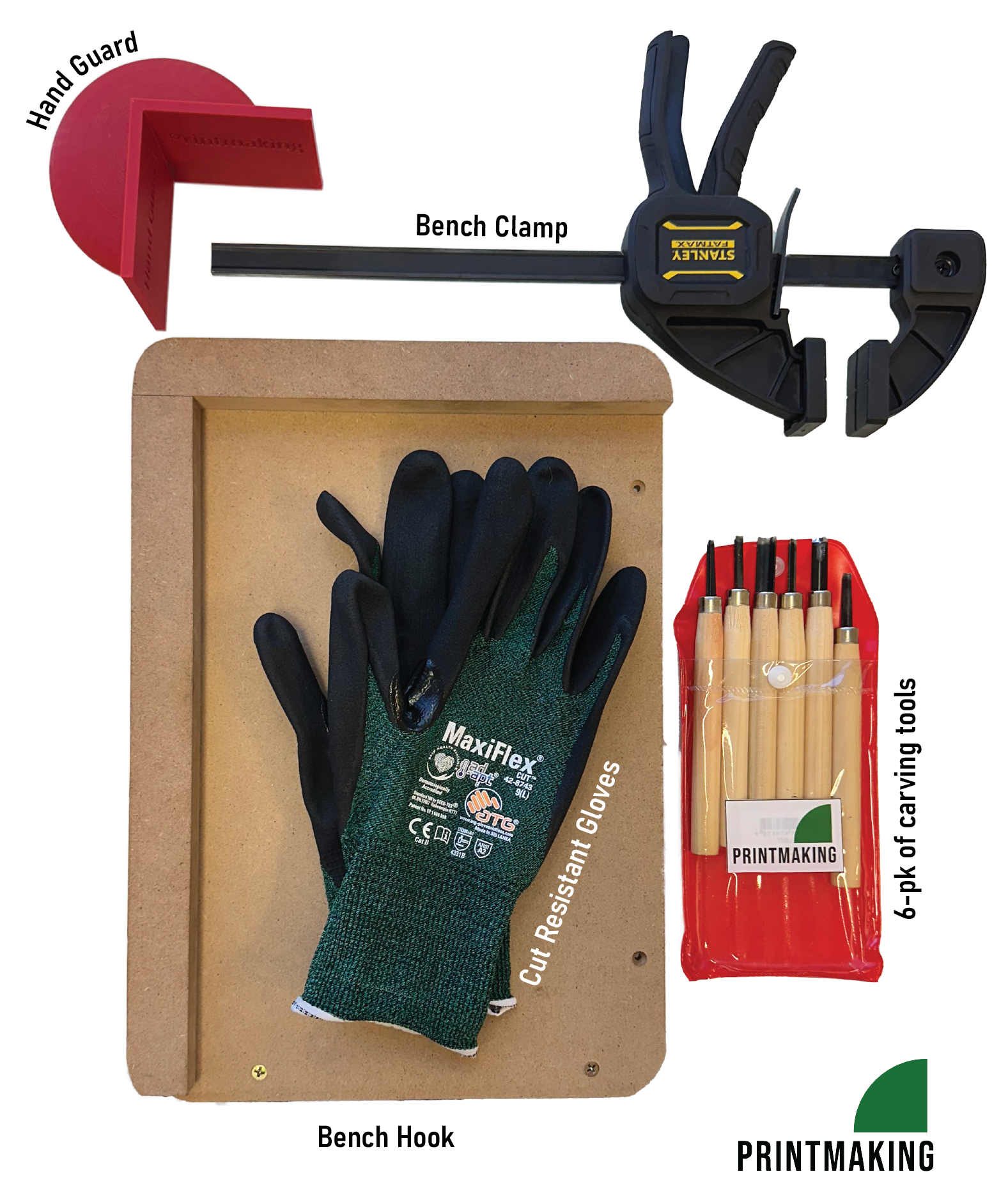
Carving kits are available to borrow from technical staff.
U-shaped tools
V-shaped tools
A range of oil-based relief printing inks are available in the workshop for you to use. The colour range is limited so you will need to mix specific colours according to your design. If you wish to use a non-oil-based relief ink, please provide your own.
While the workshop does have a limited supply of proofing or test paper, you are expected to provide your own, especially your ‘good’ printing paper.
To ensure that your image is repeatedly printed straight and/or exactly where you want it on your paper, you need to create a guide or registration sheet.
BEFORE you start inking your block, make sure you set up the press specifically for your block. It is a communal workshop so you may be sharing the press.
1.Reset the pressure boards to medium, registration sheet, plastic sheet, rubber mat.
2. Place your block on the press bed, facing up, and cover with printing paper.
3. Place the rubber mat on top and test the pressure.
4. Once the pressure is good, your ready to start to inking.
1.Select your colour, mix if needed.
2. Select your roller. Make sure the roller is wider than your block.
3. Dispense a ribbon of ink at the bottom of your slab to roll out. You only need enough ink for one print. Do not roll out all the ink you have mixed as this will be too thick.
4. Roll out the ink by rolling back and forth, lifting after each motion to allow an even coating of ink on the roller.
5. To ink up the block, ‘load’ the roller with ink and roll in one direction over the block. Reload with ink, rotate block and roll in one direction. Repeat until you achieve the desired amount of ink (this will change from block to block).
6. Line up the block on your registration sheet/press bed, line up the paper, place down rubber mat and PRINT!
7. Wet prints can be left on the drying rack.
All the Printmaking workshops are shared spaces, so you are expected to leave the workspace and tools ready for the next person.
After every print:
At the end of the printing session:
Workstation and tools
Block
Prints can be left on the drying rack to ‘cure’. Oil-based inks can take a few days to dry completely.
The racks will be cleared regularly. Check the drawers in the workshop for Unracked Prints, either the general drawer or your labelled class drawer.