CNC, or Computer Numerical Control, is a method where digital instructions control the movement of tools across two to five axes, allowing precise and automated operations. Unlike additive manufacturing, which builds objects layer by layer, CNC milling is a subtractive process - material is carefully removed from a solid block to sculpt an item with exceptional accuracy and repeatability.
A CNC machine is made up of several key components working in unison. The X and Y axes control the horizontal movement of the workpiece, while the Z axis manages the vertical travel of the spindle - the motor that rotates the cutting tool to remove material. The workpiece must be securely fixed to the machine bed, and a controller - essentially a computer - directs all of the machine's operations.
The tools used in CNC milling, known as end mills, come in various forms. Flat end mills are the most common, used for general material removal, while ball end mills handle complex curved surfaces, and chamfer mills are used for creating sharp edges and fine engravings. The geometry of a tool - particularly its flutes - also matters greatly. More flutes allow for faster cutting and a better surface finish, while fewer flutes improve chip clearing, making them better suited for softer materials.
Getting the cutting parameters right is equally important. Speeds refer to the spindle RPM, affecting tool temperature and wear, while feeds refer to the rate at which the tool advances through the material - both are vital for optimising tool life and achieving quality surface finishes. Two further parameters - Depth of Cut (DOC) and Width of Cut (WOC) - must also be balanced carefully, as deeper cuts are more efficient but place greater stress on the tool, while shallower cuts extend tool life and improve surface quality.
Finally, material selection matters. Combustible materials and graphene cannot be CNC machined, as they pose fire risks and can corrode the spindle and equipment.

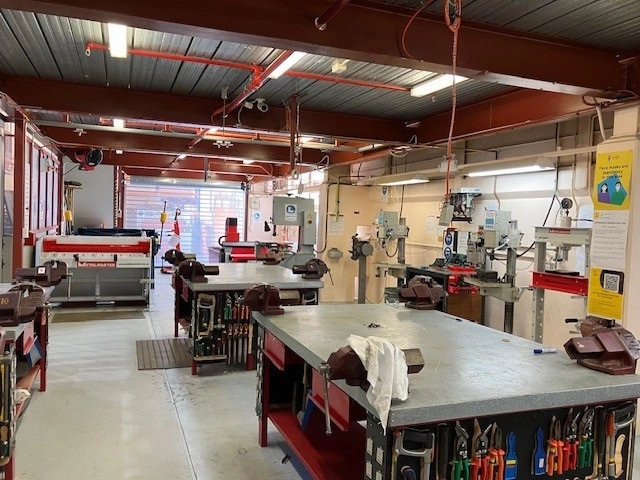
The FabLAB at UNSW Canberra is equipped to support everything from entry-level fabrication through to advanced metalwork, providing students, researchers, and staff with hands-on access to a comprehensive range of sheet metal tools, hand tools, and fabrication equipment.
With the equipment available, users can take a project from raw material through to a finished product entirely within the one space - cutting and forming sheet metal, drilling and fastening components, engraving fine details, and applying finishing techniques. The space supports teaching, student projects, HDR research prototyping, and staff development.
To get started, access is competency-based - users begin with the Metal Fabrication Fundamentals and Safety Badge before progressing to individual machine and advanced badges covering equipment such as the plasma cutter, table saw, and welding bay. Throughout, trained technical staff supervise the space, provide guidance, and ensure safety compliance.