UNSW Canberra Makerspace

CNC Tooling - End Mills and Beyond

A Closer Look at End Mills and Beyond

Tooling plays a critical role in CNC machining. The selection of the correct cutting tool directly affects machining quality, efficiency, surface finish, and tool life. This module introduces common CNC cutting tools, their geometry, and how to choose the right tool for different operations.

End Mills vs Drill Bits

Although they may look similar, end mills and drill bits serve different purposes:

  • Drill Bits
    • Designed for vertical cutting (plunging)
    • Used to create cylindrical holes
    • Limited lateral cutting capability
  • End Mills
    • Designed for both vertical and lateral cutting
    • Used for profiling, slotting, surfacing, and contouring
    • Feature cutting edges (flutes) along the sides and tip

End mills are the primary tools used in CNC milling due to their versatility.

CNC Endmills no title-04.png

Types of End Mills

_________________________________________________________________________________

A Detailed Guide to End Mills

Artboard 1

Flat End Mills

Flat end mills have a flat cutting tip and are the most commonly used CNC tools.

  • Ideal for material removal and general machining
  • Used for flat surfaces, slots, and pockets
  • Provide sharp edges and flat finishes
removing material FEM
Untitled_design_1.max-800x600

Bull Nose End Mills

Bull nose (corner radius) end mills combine a flat end with rounded corners.

  • Increased tool strength and longer life
  • Suitable for finishing operations
  • Leave internal radii on edges
Bull_Nose_2.max-800x600
Bull_Nose_3.max-800x600

Ball End Mills

Ball end mills have a rounded tip and are used for 3D machining.

  • Ideal for curved and complex surfaces
  • Common in moulds and contours
  • Produce small scallops on flat surfaces
Artboard_3_1TzMa1R.original
Artboard_1_HsO4RTl.max-800x600

Chamfer Mills

Chamfer mills have a V-shaped profile.

  • Used for creating chamfers and bevels
  • Common angles: 90° and 60°
  • Also used for deburring and edge finishing
Chamfering 1
Chamfering 2

Engraving Mills

Engraving tools are designed for fine detailing.

  • Used to engrave text, patterns, and features
  • Suitable for metals, plastics, and wood
  • Provide high precision for shallow cuts
Artboard_7_4DZxRq0.original
Artboard 8

Indexable End Mills

Indexable end mills are cutting tools that use replaceable inserts instead of solid cutting edges. These inserts can be quickly replaced without removing the entire tool, improving efficiency and reducing downtime.

  • Cost-effective for high material removal
  • Suitable for repeated or heavy-duty machining
  • Allows quick tool maintenance and consistent performance

Common Types

In UNSW Canberra makerspaces, two common types of indexable end mills are used:

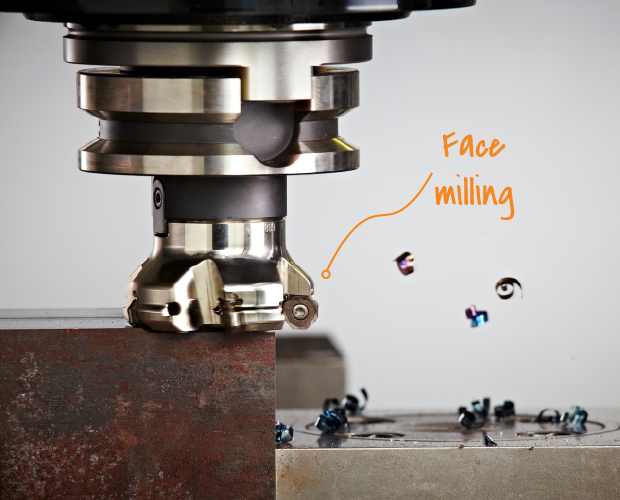
Face Mills

  • Designed for machining flat, horizontal surfaces
  • Ideal for surfacing and removing material from the top of a workpiece
  • Provide smooth and efficient finishing of large areas

Shoulder Mills

  • Designed for machining vertical surfaces and edges
  • Used for features such as slots, steps, and walls
  • Require specific cutter geometry for accurate side cutting

Key Differences

  • Face milling: focuses on horizontal surfaces
  • Shoulder milling: focuses on vertical features

Selecting the correct type ensures better accuracy, surface finish, and machining efficiency.

Artboard 1
Artboard 5
facing
Artboard_6_G4p1gp7.original

End Mill Flute Features

_________________________________________________________________________________

How Tool Geometry Influences Machining

Flutes

Flutes are the cutting edges of an end mill and play a key role in chip removal.

  • More flutes: better surface finish, higher feed rates
  • Fewer flutes: larger chip removal, better for softer materials

Helix Angle

The helix angle affects how chips are evacuated.

  • High helix: better chip removal (ideal for metals)
  • Low helix / straight: cleaner edges in softer materials

It also generates axial forces that can affect workpiece stability.

Cutting Direction

Different flute directions influence chip flow and surface finish:

  • Up Cut
    • Pulls chips upward
    • Good for metals
    • Can cause tear-out on top surfaces (wood)
  • Down Cut
    • Pushes chips downward
    • Clean top edges (ideal for plywood)
    • Can cause chip build-up
  • Compression Cutters
    • Combine up and down cutting
    • Clean finish on both top and bottom surfaces
    • Typically used for plywood
  • Straight Cutters
    • No helix, push chips sideways
    • Best suited for plastics
CNC_Endmills-02.original
up versus down cut

End Mill and Tool Holder Considerations

_________________________________________________________________________________

Selecting the Right Tool Setup

End Mill Size

The size of an end mill, including its length and diameter, directly affects machining capability, detail, and efficiency.

  • Larger end mills remove more material quickly but are limited in producing fine details
  • Smaller end mills allow higher precision and finer features but remove material more slowly

Tool Stick-Out

Tool stick-out refers to the length of the tool extending below the holder.

  • Limits the maximum height/depth of features that can be machined
  • Excessive stick-out increases vibration and risk of tool breakage
  • Insufficient clearance may cause collisions with the workpiece or fixtures

Proper stick-out selection is critical for both safety and machining accuracy.

Flute Length

Flute length determines the maximum depth of cut for the tool.

  • Cutting deeper than the flute length can cause the tool shaft to contact the material
  • This can lead to poor surface finish, tool damage, or machine faults

Always ensure cutting depth stays within the flute length.

Tool Diameter

Tool diameter affects both strength and cutting limitations.

  • Larger diameters provide greater strength and stability
  • Smaller diameters allow finer detail but are more prone to breakage

As a general rule, cutting depth should not exceed 3× the tool diameter to avoid tool failure.

CNC_Endmills-03_4wLtOec.original

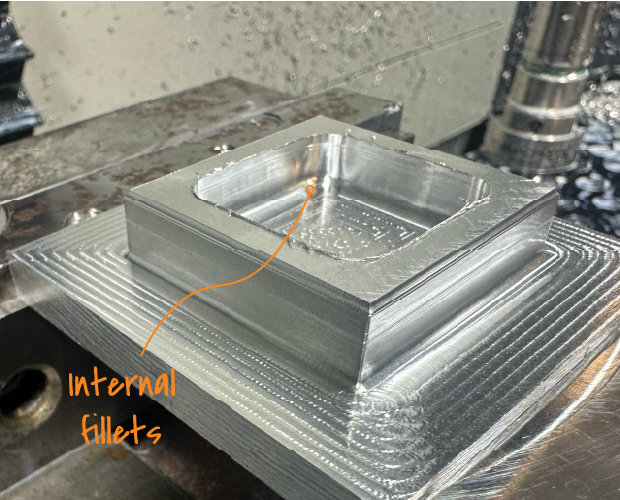
Internal Radii

Due to the rotating nature of end mills, internal corners will always have a radius equal to the tool size. Achieving perfectly sharp internal corners is not possible with CNC milling.

  • Bull nose end mills also leave fillets on bottom edges
  • Important when designing parts that must fit together (e.g., joints, slots)

This limitation must be considered during design to ensure proper assembly and fit.

Maximum End Mill Engagement (Clearing)

During material removal (clearing), tool engagement must be carefully controlled to avoid excessive load.

  • Sudden or deep engagement can cause tool breakage
  • Cutting too slowly increases friction, heat, and tool wear
  • Ideal cutting maintains a consistent tool load

To ensure safe and efficient clearing:

  • Use gradual step-down passes
  • Apply controlled radial engagement (step-over)
  • Avoid aggressive cuts

Proper clearing strategies improve tool life and machining performance.

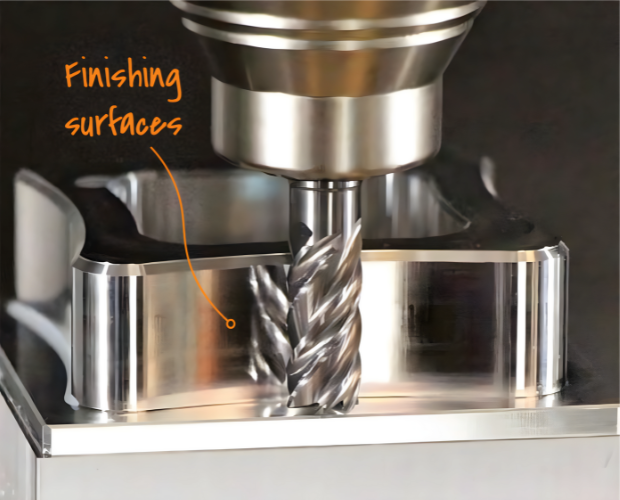
Maximising Engagement (Finishing)

Finishing removes a small amount of material to achieve high surface quality and precision.

  • Use lower cutting forces to reduce vibration and tool deflection
  • Maintain smooth and consistent tool movement

For best results:

  • Use the maximum flute length for vertical surfaces
  • Maximise tool engagement when finishing flat surfaces
  • Avoid cutting with the centre of the tool during facing
  • Maintain higher surface speeds for improved finish

Careful finishing techniques are essential for achieving accurate dimensions and high-quality surfaces.


Using_Dogbones_v1-02.original